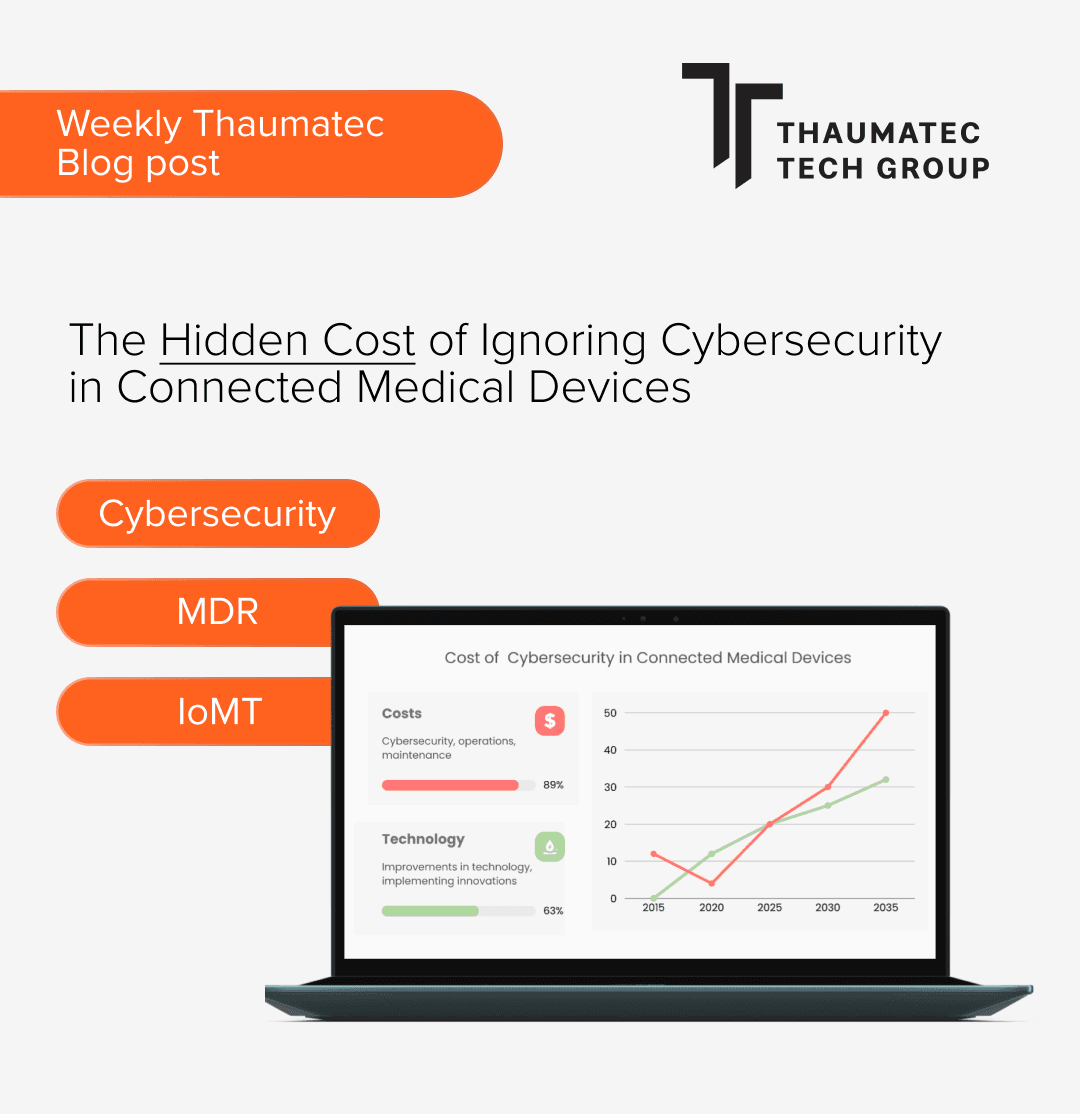
The Hidden Cost of Ignoring Cybersecurity in Connected Medical Devices
There's a version of a connected medical device that works perfectly in a demo. Sensors read correctly. Data flows to the cloud. The app displays real-time vitals. Investors are impressed. Then comes the real world: a hospital network with strict security requirements, a regulatory submission that stalls for six months because the technical documentation doesn't cover cybersecurity risk management, a penetration test that finds critical vulnerabilities in the firmware. This is not an unusual story. It's the standard trajectory for healthtech companies that treat cybersecurity as something to sort out after the product works.
A Different Threat Environment
For example, a fitness tracker that leaks data is embarrassing. A connected medical device that leaks data (or can be manipulated) is a patient safety issue, a regulatory failure, and a legal liability simultaneously.
IoMT devices process sensitive health data, integrate with hospital information systems, and often run continuously with limited ability to push security updates without clinical downtime. Healthcare is consistently the most expensive sector to breach: according to IBM's Cost of a Data Breach Report, the average cost of a healthcare incident is nearly $11 million — almost double the cross-industry average. That figure doesn't include regulatory action, product recalls, or reputational damage.
The Regulatory Reality
Cybersecurity is no longer a design choice. It's a compliance requirement.
In the EU, the Medical Device Regulation (MDR) require manufacturers to address cybersecurity throughout the product lifecycle as a condition of market authorization. In the US, the FDA requires threat modeling, a software bill of materials (SBOM), and a post-market cybersecurity management plan as part of device submissions. IEC 81001-5-1 defines what "secure by design" means in practice.
Regulators on both sides of the Atlantic are raising the bar. A product built without security architecture in mind will require expensive rework to meet current requirements — if it can be reworked at all without a ground-up rewrite.
Cybersecurity by Design and by Operations
In medical device software development, cybersecurity by design means threat modeling before architecture is finalized, encryption and access control as non-negotiable constraints from day one, and a Quality Management System that documents every security-relevant decision for the audit trail regulators will scrutinize.
It also means thinking about the full stack. A connected medical device involves firmware, a cloud backend, an AI layer, and HIS integration. Each connection point is a potential attack surface. Security architecture that covers only one layer is a partial answer to a complete problem.
And it doesn't end at CE marking or FDA clearance — it begins there. Keeping a device secure and compliant over years of deployment, as the threat landscape evolves and software dependencies age, is a separate and ongoing challenge that most early-stage companies severely underestimate.
What This Means in Practice
The cybersecurity decisions made in the first months of product development determine whether a regulatory submission succeeds or stalls, whether a pilot can expand into real clinical deployment, and whether a future security incident stays contained.
Companies that build with cybersecurity by design from the start find the investment pays back at exactly the moments it matters most: certification, deployment, and investor due diligence. Those that treat it as a checkbox pay later — when it's harder to fix and more expensive to absorb.
In a market where connected medical devices are proliferating and regulatory scrutiny is increasing, cybersecurity is not a differentiator. It's the price of entry.
Thaumatec is a medical device software company based in Wrocław, Poland, building IoMT platforms, embedded systems, and AI-integrated medical software with cybersecurity and compliance built in from day one. Learn more at thaumatec.com.