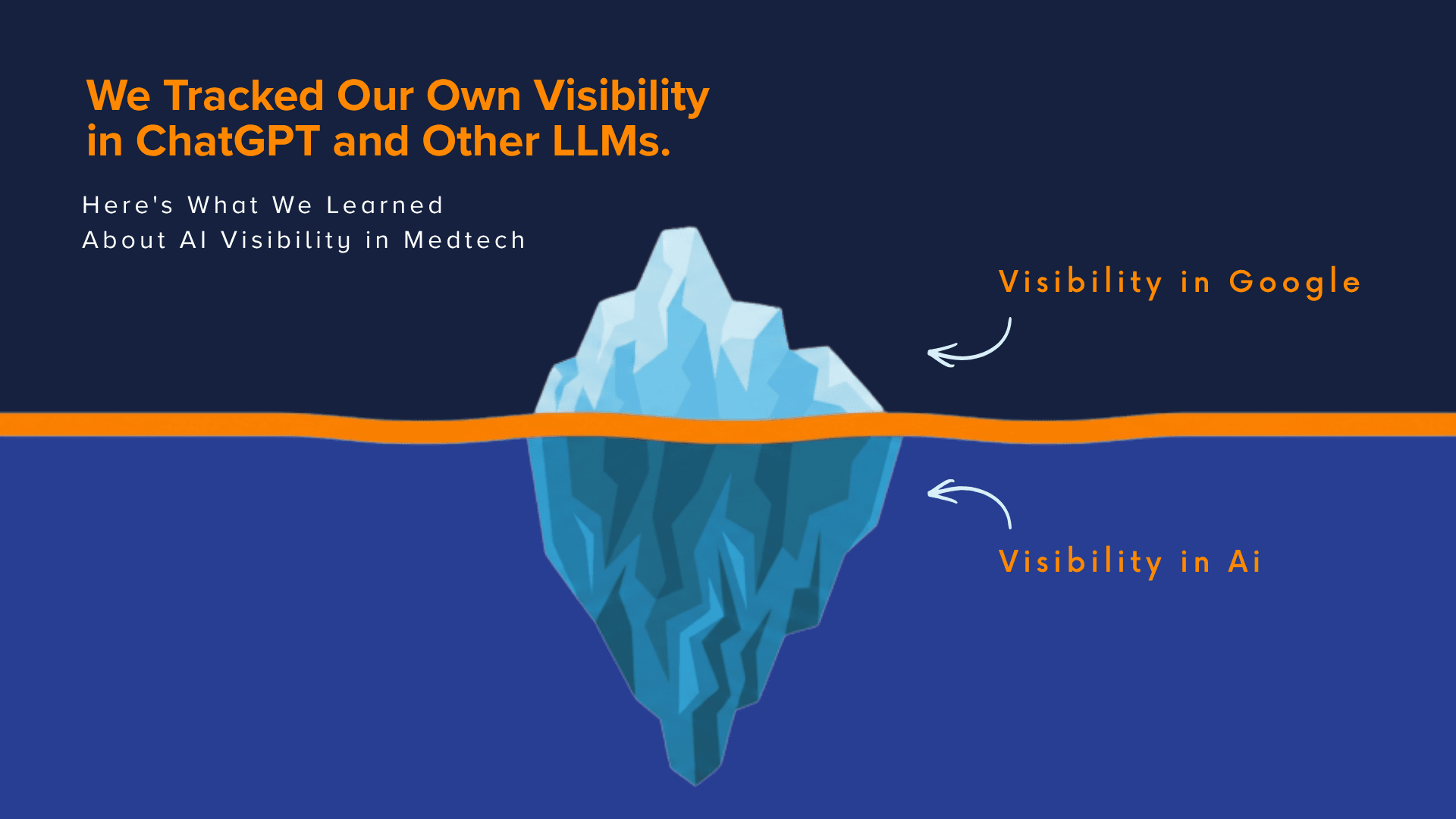
We Tracked Our Own Visibility in ChatGPT and Other LLMs. Here's What We Learned About AI Visibility in Medtech
Buyers evaluating medical device software partners no longer start with a Google search. Increasingly, they open ChatGPT, Perplexity, or Claude and type something like: "Recommend a reliable company for developing AI powered medical device software under a 100k budget." That shift is quietly rewriting the rules of B2B discovery in health tech. Most vendors, including well established ones, have no idea how invisible they already are. We decided to find out where Thaumatec stood.
What we tested
We ran roughly 50 realistic buyer prompts through an AI visibility tracker, covering the categories that matter most in medtech software services: AI/ML integrated SaMD development, IoMT connectivity, regulatory compliance consulting, cybersecurity for connected devices, and embedded systems engineering.
The prompts mirrored how real buyers phrase these searches. Not branded queries, but the kind of transactional language a procurement lead or CTO actually types when scoping vendors: "Identify a consultant for medical software development that ensures strict regulatory compliance." "List providers specializing in life science regulatory consulting for embedded systems." "Evaluate top tier cybersecurity partners for AI integrated diagnostic software systems."
We tested this on Thaumatec's own visibility as a working example, not as a vanity exercise.
The pattern
On broad, category level prompts, the ones with the highest search volume and the clearest commercial intent, Thaumatec's visibility sat at 0%. Not low. Zero. The models simply did not surface us at all on these queries, which suggests classic SEO signals and AI visibility are measuring something different.
The moment a prompt narrowed to a specific geography plus a specific niche, for example pairing a location with "medical software" or "IoMT connectivity," visibility jumped meaningfully, in some cases into double digits. A prompt like "find me a reliable partner for medical device security" returned nothing. A prompt like "find me a reliable healthtech software company in Wroclaw" surfaced Thaumatec directly.
That is a strange gap by SEO standards. A well optimized page tends to rank reasonably across a cluster of related queries, not appear only when a query gets hyper specific. AI answer engines are clearly working from a different signal set.
Why broad prompts are the hardest to win
Large language models do not rank pages the way search engines do. When answering a recommendation style prompt, they are synthesizing from whatever entities and companies appear repeatedly and consistently across their training and retrieval sources: analyst write ups, review platforms, association directories, press coverage, forum and LinkedIn discussion, comparison articles written by third parties.
A company's own website, however well built, is a weak signal in this system. It is a primary source about itself, not a corroborating one. What seems to move a company from invisible to mentioned is third party reinforcement: being named unprompted by other publishers, listed in category directories, cited in "top vendors" roundups, or referenced in comparison content the model can draw from.
Narrow the prompt, add a city, a budget ceiling, a specific compliance requirement, and the candidate pool shrinks. With fewer plausible answers, even a thin signal like a single directory listing or a locally relevant mention is enough to surface a name that would otherwise get lost among category leaders on the broad query.
What this means for Thaumatec, and probably for you too
The takeaway is uncomfortable but useful: SEO health and AI visibility are not the same discipline anymore. Category level buyer intent, arguably the highest value traffic there is, is currently the hardest to win without a deliberate, separate strategy.
A few things appear to correlate with stronger AI visibility based on what we found:
- Directory and association presence - Category defining directories (Clutch, G2, MedTech Europe listings, national medtech associations) function less like backlinks and more like structured facts a model can retrieve and trust.
- Third party comparison content - Being named in someone else's "best vendors for X" article carries more weight toward an AI recommendation than a self published "why choose us" page ever will.
- Consistent entity naming - Inconsistent company naming across the web appears to dilute how confidently a model associates a brand with a category.
- Niche specific corroboration - Narrow mentions, a case study cited by a partner, a conference speaker bio, a regional trade press feature, punch above their weight because they match the long tail, specific way buyers now phrase AI prompts.
Where we go from here
We are treating this as an open problem rather than a solved one. It is not yet clear whether AI visibility on broad category prompts is something a mid sized specialist can realistically close, or whether it structurally favors incumbents with years of accumulated third party mentions. What is clear is that long tail, specific queries reward exactly the kind of niche credibility a specialist firm can build faster than a generalist can.
If you are marketing a medtech or health tech company, the practical move is simple: audit your own visibility across a real set of buyer phrased AI prompts, not just your Google rankings. The gap between the two is probably where your next quarter of marketing effort belongs.
*Methodology note: findings based on AI visibility tracking of Thaumatec across roughly 50 non-branded, transactional prompts relevant to medical device software development, IoMT, regulatory compliance, and cybersecurity services, run against current generation conversational AI models.*